
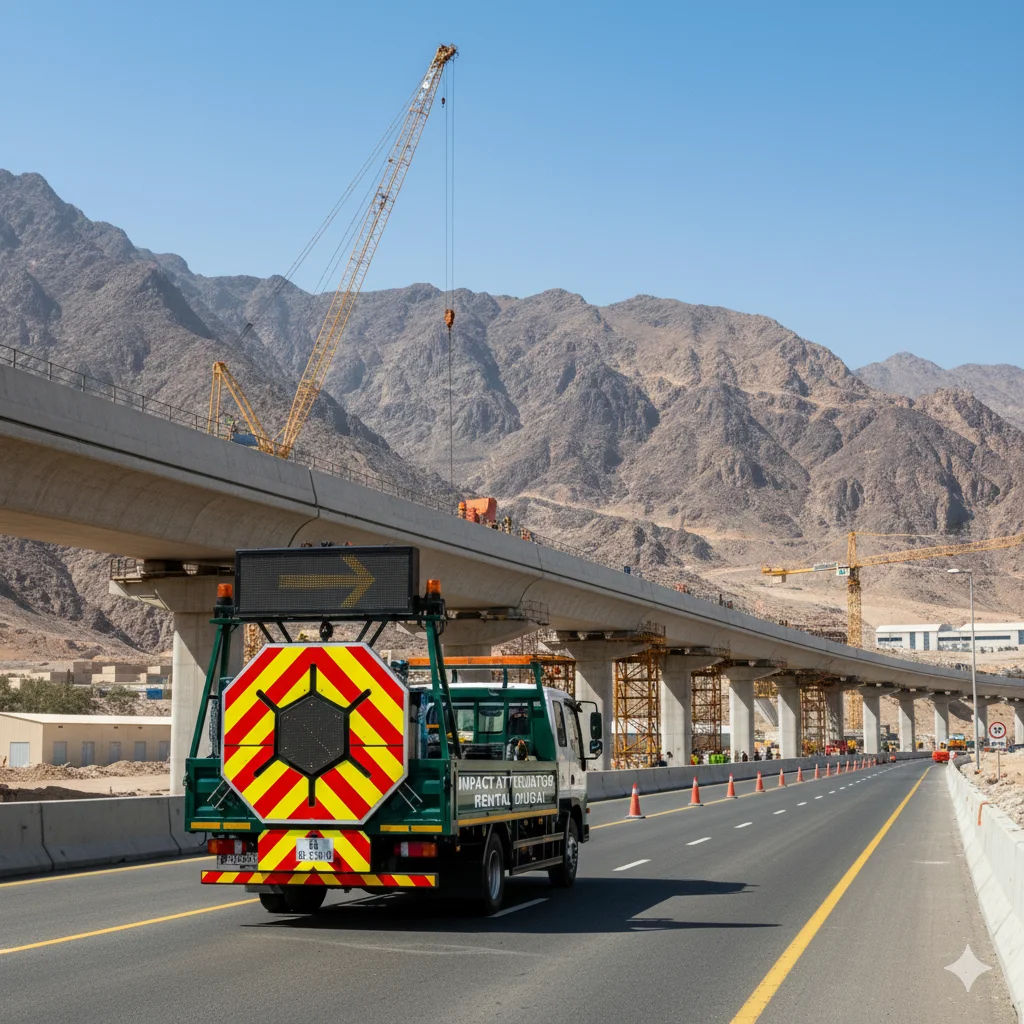
Urban vs. Highway: Choosing the Right Attenuator for Abu Dhabi Projects
When selecting a Truck Mounted Attenuator (TMA) rental in Abu Dhabi, the most critical decision you will make is choosing between Test Level 2 (TL-2) and Test Level 3 (TL-3) equipment. This choice isn’t just a matter of preference—it is a technical requirement based on the kinetic energy of the road you are working on. Understanding the difference between these two levels is essential for keeping your project compliant and your team safe.
The Science of Speed: Why Test Levels Matter
To understand the difference between TL-2 and TL-3, we must look at the international standards set by NCHRP 350 and the more recent MASH (Manual for Assessing Safety Hardware) guidelines. These standards classify crash cushions based on the maximum impact speed they can safely absorb without causing fatal G-forces to the vehicle occupants or allowing the vehicle to penetrate the work zone.
TL-2 Attenuators: These are designed and tested for impact speeds up to 70 km/h (approx. 45 mph). They are more compact, lighter, and ideal for environments where traffic is naturally slower or restricted.
TL-3 Attenuators: These are the “heavy lifters” of the safety world, tested for impact speeds up to 100 km/h (approx. 62 mph). Because kinetic energy increases with the square of the speed, a TL-3 unit must be significantly more robust to absorb the massive forces generated during a high-speed highway collision.
When to Rent a TL-2 TMA: The Urban Specialist
In the heart of Abu Dhabi’s urban landscape, speed limits are strictly controlled by the Integrated Transport Centre (ITC). Residential zones often see limits of 40 km/h, while internal city dual carriageways typically top out at 60 km/h or 80 km/h. In these scenarios, a TL-2 TMA rental is often the most efficient choice.
Best Applications for TL-2:
Residential Street Maintenance: Repairs in areas like Al Bateen or Mohammed Bin Zayed City where speed limits are naturally low.
City Center Utility Work: Short-term repairs where the physical footprint of a full highway-sized truck would cause unnecessary congestion.
Landscaping and Cleaning: Mobile operations like street sweeping or median irrigation on internal city roads.
The primary advantage of the TL-2 unit in an urban setting is its maneuverability. Abu Dhabi’s downtown corridors can be narrow; a more compact TL-2 truck can navigate tighter turns and fit into smaller work zones while still providing a certified level of protection for the crew.
When TL-3 is Mandatory: The Highway Shield
Once you move toward the Emirate’s major arteries, the safety requirements change drastically. On highways like the E10, E11, or E20, Abu Dhabi has eliminated the 20 km/h “speed buffer,” meaning traffic flows at a consistent and high velocity. For any road with a speed limit of 80 km/h or higher, a TL-3 Truck Mounted Attenuator rental is not just recommended—it is a mandatory requirement for ITC compliance.
Best Applications for TL-3:
Major Highway Expansion: Long-term projects on the main routes connecting Abu Dhabi to Dubai or Al Ain.
Bridge and Tunnel Inspections: Working on the iconic Yas Island bridges or the Sheikh Zayed Tunnel where speeds are consistently high.
Emergency Response on Expressways: Providing a buffer for broken-down vehicles or sudden debris removal on high-speed roads.
A TL-3 unit is essentially a giant energy-absorbing cartridge. When a car hits a TL-3 attenuator at 100 km/h, the system is designed to crush in progressive stages, slowing the vehicle down to a stop over a distance of several meters. Using a TL-2 unit on a 100 km/h road is a recipe for disaster, as the unit would likely “bottom out” or fail to stop the vehicle before it reached the workers.
The Risk of Under-Speccing Your Rental
In the competitive world of UAE construction, it can be tempting to opt for a lower-rated unit to save on rental costs. However, in Abu Dhabi, the regulatory consequences of “under-speccing” your safety equipment are severe.
If an ITC inspector or Abu Dhabi Police officer visits your site on the E11 and finds a TL-2 rated attenuator protecting a high-speed work zone, the project will be shut down immediately. More importantly, the liability in the event of an accident is insurmountable. If a crash occurs and it is proven that the equipment was not rated for the road’s speed, the contractor faces massive fines and potential criminal negligence charges.
Conclusion: Matching Protection to the Environment
Choosing between a TL-2 and TL-3 TMA is about more than just checking a box on a safety form; it’s about accurately assessing the danger of the environment. In the quiet streets of the city, the TL-2 offers a compact and effective solution. On the thundering highways that define the UAE’s connectivity, the TL-3 is the only acceptable standard.
When you partner with a professional TMA rental service in Abu Dhabi, you gain more than just a truck; you gain the expertise to choose the right tool for the job. By matching the test level of your attenuator to the speed of the traffic, you ensure that every project—whether in the heart of the city or on the edge of the desert—is built on a foundation of uncompromised safety.
Information
Services
Contact Us
- +971 55 172 7024
- Earthmoversinfo@gmail.com
- Capital Golden Tower Office 706 – 7 floor – Dubai