
Navigating ITC Standards: The Critical Role of TMA Requirements in Abu Dhabi Roadworks
Navigating ITC Standards: The Critical Role of TMA Requirements in Abu Dhabi Roadworks
The landscape of Abu Dhabi is defined by its rapid transformation and world-class infrastructure. From the towering skylines of Al Maryah Island to the sprawling highway networks that connect the Western Region, the Emirate’s roads are the arteries of its economy. However, maintaining these roads is a high-risk endeavor. For contractors and project managers, the priority is twofold: completing the project on time and ensuring the absolute safety of the workforce and the motoring public. This is where the Integrated Transport Centre (ITC) standards come into play, specifically regarding the deployment of Truck Mounted Attenuators (TMAs).
Understanding the regulatory environment in Abu Dhabi is essential for any construction firm. The Department of Municipalities and Transport (DMT), through the ITC, has established rigorous frameworks to govern how roadworks are conducted. These are not merely suggestions; they are strict mandates designed to minimize the risk of “secondary accidents,” where motorists collide with work zones. In this context, a Truck Mounted Attenuator is more than just a piece of equipment—it is a life-saving barrier and a cornerstone of regulatory compliance.
The Foundation of Safety: ITC TR-531 and Beyond
The primary document governing road safety in the Emirate is the ITC Work Zone Manual (often referenced alongside TR-531). This manual dictates exactly how a traffic diversion should be set up and what kind of protection vehicles are required. According to these standards, any mobile or short-term work operation on high-speed roads must utilize a “shadow vehicle” equipped with a certified crash cushion.
In Abu Dhabi, the standard for these cushions is exceptionally high. The ITC generally requires equipment that meets international crash-test levels, specifically NCHRP 350 or the more modern MASH (Manual for Assessing Safety Hardware) standards. For contractors, this means that a standard truck with a few flashing lights is no longer sufficient. To pass a site inspection by the Abu Dhabi Police or ITC inspectors, your vehicle must be equipped with a TMA that is rated for the specific speed of the road.
TL-2 vs. TL-3: Matching Equipment to the Speed Limit
One of the most common points of confusion for contractors is the distinction between Test Level 2 (TL-2) and Test Level 3 (TL-3) attenuators. The choice between these two is dictated entirely by the posted speed limit of the road where the work is being performed.
On urban streets within Abu Dhabi city, where speed limits are typically 60 km/h or 70 km/h, a TL-2 rated attenuator may be permissible. These units are designed to absorb the impact of a vehicle traveling at speeds up to 70 km/h. However, the vast majority of infrastructure projects in Abu Dhabi take place on arterial roads and highways like the E11 (Sheikh Zayed Bin Sultan Street) or the E10. On these routes, where speeds regularly exceed 100 km/h, TL-3 compliance is mandatory. A TL-3 TMA is engineered to withstand impacts from vehicles traveling at 100 km/h, dissipating the kinetic energy through a collapsible aluminum or composite cartridge. Renting a TL-3 unit ensures that your project remains compliant across all road types in the UAE, providing a “one-size-fits-all” safety solution for diverse project portfolios.
The Mechanical Necessity of a Shadow Vehicle
Why is the ITC so insistent on the use of TMAs? The answer lies in physics. When a distracted driver veers into a work zone, a standard truck acts as a solid, immovable object. The sudden deceleration can be fatal for the driver of the impacting vehicle and can send the truck careening into the workers ahead.
A Truck Mounted Attenuator acts as a giant “crumple zone.” Upon impact, the TMA cartridge collapses in a controlled manner, absorbing the energy of the crash and slowing the impacting vehicle down over a distance of several feet. This technology protects three distinct groups: the motorist who hit the truck, the driver of the TMA truck itself, and the crew working in front of the vehicle. By requiring these units, the ITC is significantly reducing the mortality rate of roadwork-related accidents in the capital.
Operational Compliance: Beyond the Cushion
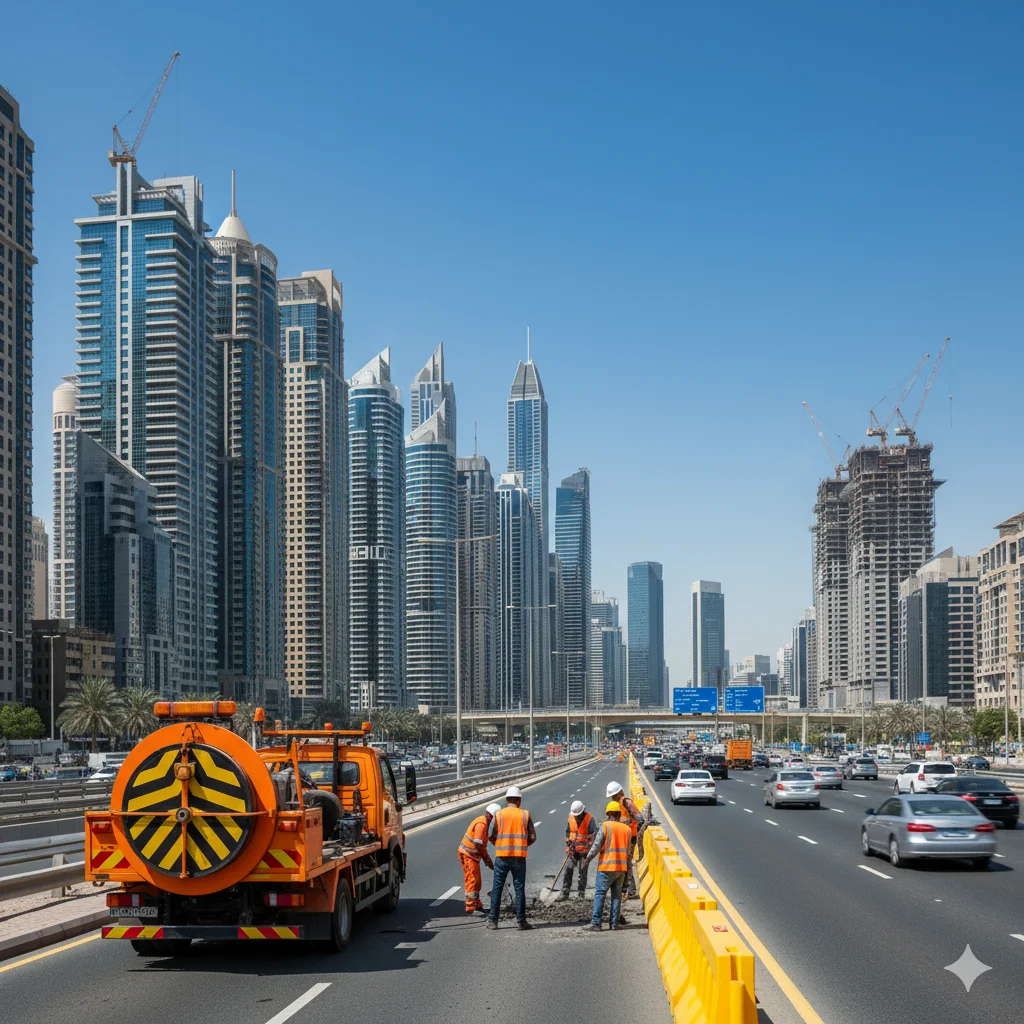
Meeting ITC standards involves more than just having a crash cushion attached to a truck. The “conspicuity” of the vehicle is equally important. In Abu Dhabi, TMA trucks must be highly visible to give drivers ample time to change lanes. This involves the use of high-intensity prismatic reflective tape (often in a chevron pattern) and a robust electronic signaling system.
Most TMA rentals in Abu Dhabi come equipped with a large LED Arrow Board or a Variable Message Sign (VMS). These signs are synchronized with the traffic diversion plan (TDP) approved by the ITC. They tell drivers exactly what to do—”Keep Left,” “Keep Right,” or “Merge.” Without these electronic aids, a TMA truck is only half-compliant. Furthermore, the truck must be weighted appropriately. A TMA cushion is only effective if the “host vehicle” (the truck it’s attached to) has enough mass to resist being pushed forward into the work zone. This is why professional rental services ensure that their trucks are ballasted according to the manufacturer’s specifications.
The Economic Advantage of Rental in Abu Dhabi
For many contractors in the UAE, the decision to rent a TMA versus purchasing one is driven by the strictness of the ITC. Safety standards are constantly evolving. Buying a TMA today might mean owning an obsolete piece of equipment in three years if the regulations shift toward newer MASH standards.
By opting for a Truck Mounted Attenuator rental in Abu Dhabi, companies can access the latest, most compliant models on a project-by-project basis. This eliminates the need for specialized maintenance, hydraulic testing, and the storage of bulky equipment during the off-season. It also ensures that if an ITC inspector visits the site, the equipment is in peak condition, with all certifications and test levels up to date.
Conclusion: Safety as a Standard
In Abu Dhabi’s competitive construction sector, your reputation is built on your safety record. Following the ITC standards for Truck Mounted Attenuators isn’t just about avoiding fines; it’s about demonstrating a commitment to the highest international safety protocols. As the city moves toward its Vision 2030 goals, the focus on “Zero Accidents” in work zones will only intensify. Partnering with a reliable rental provider ensures that you have the right shield in place, allowing you to focus on building the future of Abu Dhabi while we protect the present.
Information
Services
Contact Us
- +971 55 172 7024
- Earthmoversinfo@gmail.com
- Capital Golden Tower Office 706 – 7 floor – Dubai